Why foil transfer fails before the press even starts
Most foil faults begin with the wrong match between the substrate, die, foil and press settings. Card stock with a coated surface behaves very differently from uncoated board, and laminated cartons need a different approach again. If a job that ran well last month suddenly starts giving light spots or dull sections, check whether the board batch, humidity or coating has changed.
In Johannesburg and the West Rand, dry winter air and seasonal dust can affect static and dust build-up on paper. On the coast, moisture in the air can soften some board types and change how the foil releases. That means a job set up for Randburg may not behave the same way when it is run in Durban or Gqeberha.
A proper first check should always include the material, the die and the press condition. If one part is out, the transfer will show it very quickly.
Patchy foil usually points to heat, pressure or surface issues
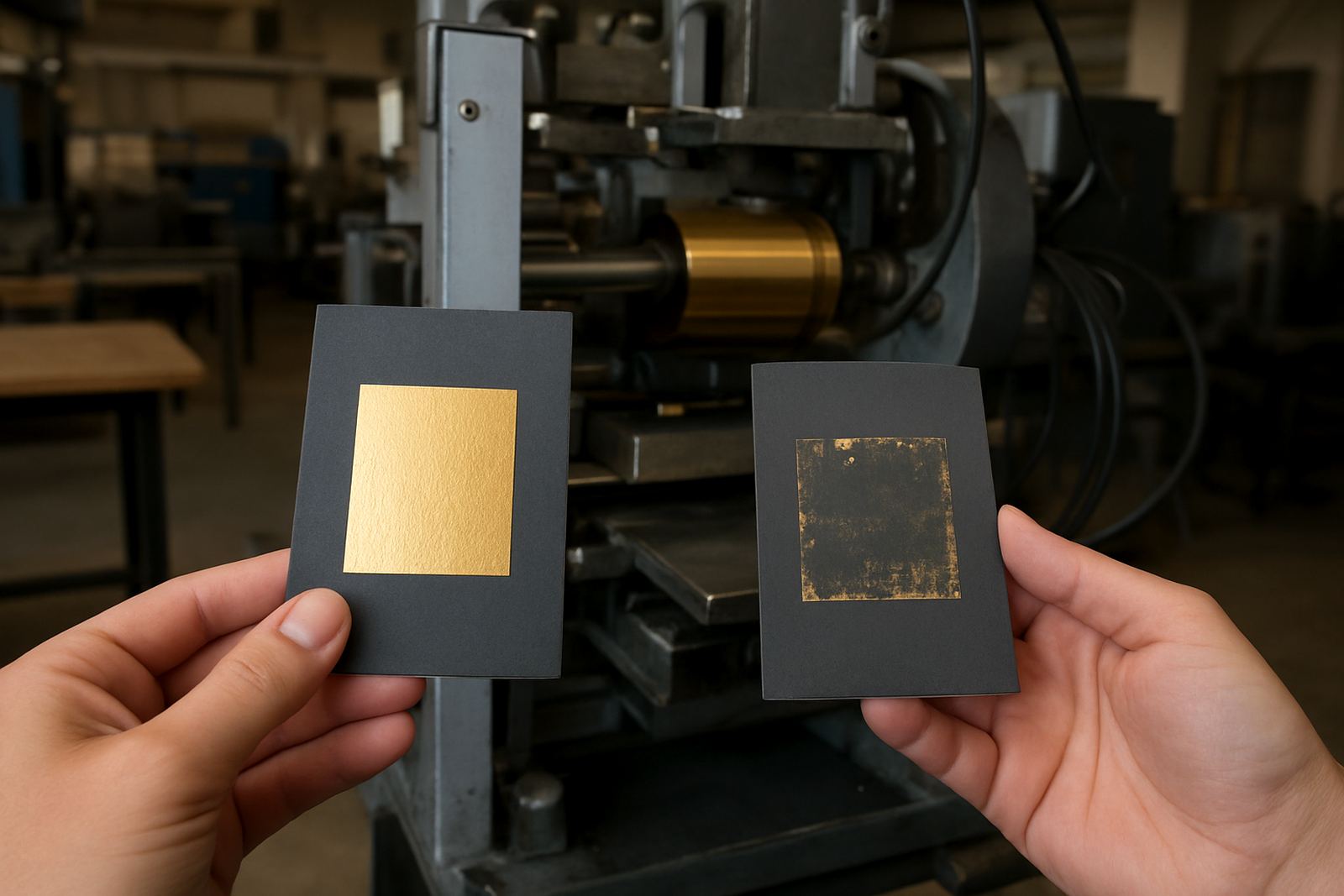
Patchy foil is one of the most common complaints, and it often shows up as missing sections, pale marks or a finish that looks uneven from sheet to sheet. The cause is often too little heat, uneven pressure across the bed, or a surface that is not accepting the foil cleanly. On some jobs the issue is caused by a dirty sheet, on others the die is not reaching a stable temperature.
Weak adhesion can also come from varnish, laminate or ink that has not fully cured. If the printed area still feels soft or slick, the foil may release but not lock down properly. That is why it is worth allowing print to dry fully before any transfer work starts.
- Check that the heater has reached the correct temperature and stayed there long enough.
- Look for pressure variation from side to side or top to bottom.
- Inspect the stock for coating changes, dust or finger marks.
- Confirm that inks, varnish or laminate are fully cured before stamping.
Weak adhesion is often a material or prep problem
When foil looks good on the press but rubs off later, the problem may be less about appearance and more about bond. Weak adhesion can be caused by the wrong foil grade, an unsuitable board surface or an unclean die. Some metallic finishes need a firmer hit, while some pigmented foils need a narrower temperature window to grab properly.
Operator handling matters too. If sheets are stacked where dust, oil or adhesive residue can land on them, the transfer area becomes unreliable. Small craft businesses sometimes assume they need a new press when the real issue is poor storage or rushed prep. In one Johannesburg case, a packaging shop in Industria West was fighting lift on a two-colour carton. The press settings had been adjusted repeatedly, but the actual fault was a batch of board stored near a loading bay where dust and afternoon heat had changed the surface behaviour.
Once the stock storage was improved and the press was recalibrated, the job settled down and waste dropped sharply.
Over-stamped edges mean the setting is too hot, too wet or too soft
Over-stamping, or foil spread beyond the intended area, usually means the press is working too hard for the job. Too much heat can soften the adhesive layer and make the foil creep past the die line. Too much pressure can also force the foil into areas that should stay clean. On finer packaging jobs, even a few extra millimetres can spoil the finish.
Sometimes the fault starts with the die itself. If the die is worn, damaged or mounted unevenly, the transfer will not stop cleanly at the edge. A poor mount can also create slight movement during the stroke, especially on larger format work. That is why die mounting and pressure setup should be treated as part of the production process, not just an admin step before the run.
If the over-stamped area appears only on one side, look at platen level, bed flatness and blanket condition if applicable. If it shows on every sheet, the settings are likely too aggressive.
Load-shedding and power dips can throw the whole job off
South African plants know that power interruptions can affect more than the lights. A short dip during warm-up may leave the heater unstable, while a restart after load-shedding can upset pressure, timing and temperature balance. If the press resumes too quickly, the machine may look ready but still be out by a few degrees or a fraction of a second, and that is enough to change the transfer.
For busy packaging runs in Midrand or Germiston, it helps to record the last known good settings and check them again after any shutdown. Keep an eye on heater calibration, timing controls and any component that may drift after a restart. It also pays to inspect wiring, connectors and control panels more often in older workshops where repeated power interruptions have taken their toll.
- Save proven settings for each stock and foil combination.
- After a shutdown, allow the press to stabilise before starting production.
- Check temperature readings with a verified gauge if results change suddenly.
- Schedule preventive servicing before peak order periods.
How to reduce waste before it becomes a production headache
The quickest way to cut common transfer problems is to work in the same order every time. Confirm the stock, inspect the die, match the foil to the job and verify temperature and pressure before the first sheet. Train operators to recognise early warning signs such as dull patches, edge spread, noisy pressure changes or a smell of overheating. Small signs often appear before a full run starts failing.
If a job is already unstable, stop and reset instead of trying to push through. A few wasted sheets are cheaper than a full batch of cartons or cards being rejected by a client. Production optimisation is usually about discipline, not dramatic changes. Clear records, regular servicing and proper operator training prevent most repeat faults.
For businesses working across Johannesburg, Roodepoort, Sandton and beyond, support that includes breakdown repairs, spares supply and foil matching can make the difference between a short delay and a missed deadline. The aim is not only to fix the fault but to understand why it happened so it does not keep coming back.
When to call in technical support
Some faults can be corrected on the floor, but recurring transfer issues need a closer inspection. If the same patchy mark keeps appearing, if the press runs hot and still does not bond, or if over-stamping returns after every adjustment, the machine likely needs a technical check. Heater calibration, pressure setup and die mounting should be verified together, because one weak point can hide another.
It is also worth asking for help when a new foil or new substrate is introduced, or when the job moves from a short craft run to a longer commercial batch. The setting that works on 500 cards may not hold on 5,000 cartons. A proper installation review and operator refresher can save time later, especially where the team is changing shifts or working under delivery pressure.
With careful setup and routine servicing, most common transfer problems can be brought under control before they affect dispatch.