Why air quality matters on every press stroke
Pneumatic presses depend on steady compressed air to drive cylinders, hold pressure and return parts to position the same way on every cycle. When the air line is clean and stable, the press gives repeatable results on card, board and packaging runs, with fewer rejects and less operator intervention.
In many Johannesburg workshops the problem is not the press itself, it is the supply. Dust from production areas, water in lines after cold mornings, or pressure drops when several machines start at once can all change how the press behaves. You may see inconsistent foil contact, slow cycling or seals that wear out sooner than they should.
What a press needs from the compressor room
The first job is simple: deliver enough air at the right pressure, with as little moisture and oil carryover as possible. A press that is set up for one pressure range should not be expected to perform well if the line is drifting up and down through the shift. Even small changes can affect pressure setup and die mounting accuracy.
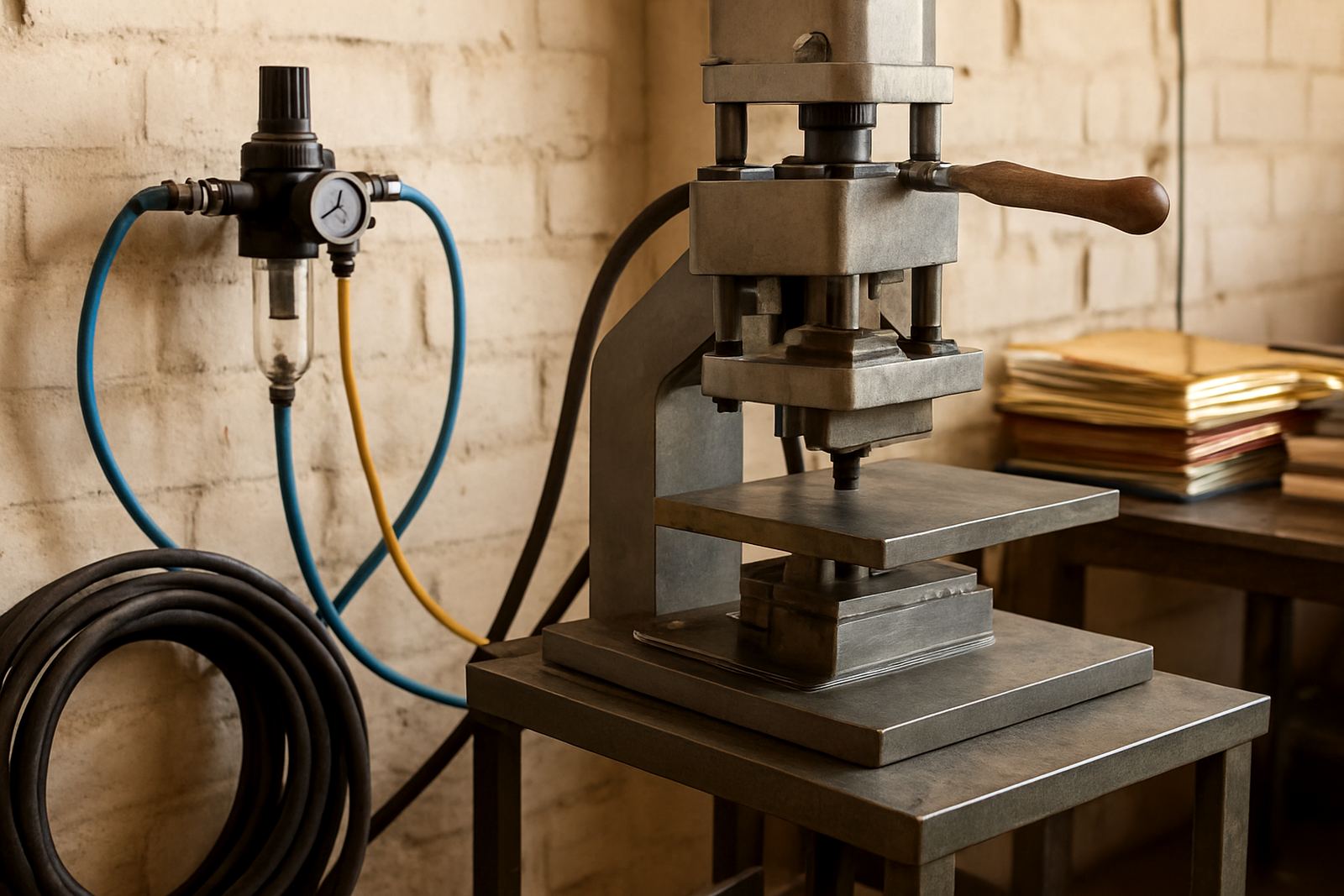
For most production environments, it helps to think in three parts, supply, treatment and delivery. The compressor must produce enough volume, the air treatment equipment must clean it, and the pipework must get it to the machine without too much loss. Long runs through a hot workshop or across an uneven floor can create pressure drop, which is why line design matters as much as the compressor size.
- Check the working pressure at the machine, not only at the compressor.
- Keep drain traps and filters easy to reach for daily checks.
- Use pipe sizes that suit the actual demand, not just the minimum fitment.
- Label isolation valves so operators can shut down quickly during faults.
Moisture, dust and oil are the usual troublemakers
Water in the line is a common cause of trouble in local workshops, especially where the compressor runs early in the morning and the air cools down in the pipework. That moisture can collect in valves, fittings and cylinders, then show up as sticking, chatter or delayed movement. Dust makes the problem worse by mixing with oil and forming grit inside moving parts.
Oil carryover is another issue where equipment is not serviced often enough. It can contaminate fittings, soften seals and leave residues that attract more dust. In a packaging plant, that means extra cleaning. In a smaller craft operation, it may mean a press that works fine on Monday and starts giving trouble by Thursday because the line has not been drained.
- Drain the receiver tank and line filters regularly.
- Inspect for water at the first outlet of the day.
- Watch for oily residue around fittings, cylinders and quick couplers.
- Replace worn hoses before they split under load.
Stable pressure keeps output repeatable
Repeatable performance starts with consistent pressure at the point of use. If the supply drops during peak demand, the press may complete a cycle but not with the same force or timing. That can affect foil transfer, die impression and the quality of the finished pack. Operators often blame the tooling when the real issue is that the air supply is changing during the shift.
It is worth checking what else is on the same line. A cutter, stapler or other air tool can steal volume from the press if the system is not separated properly. During load-shedding recovery, some sites bring everything back online at once, which can cause a pressure dip just when production restarts. A staggered start-up helps, as does proper storage in the receiver tank.
A practical checklist for workshops in Johannesburg
A well-run air system saves time and reduces callouts. In Industria West, Roodepoort and Randburg, we see the same pattern: once the air supply is sorted, many press faults become easier to diagnose and faster to fix. The machine may still need servicing, but it is no longer fighting a poor supply every minute of the day.
Use this checklist during weekly maintenance or before a busy production run:
- Confirm pressure at the press with a reliable gauge.
- Check that filters are not blocked and drains are working.
- Listen for leaks around couplers, fittings and cylinders.
- Make sure hoses are not kinked, crushed or rubbed through.
- Verify that the compressor cycle matches the plant demand.
- Inspect the room for excessive dust, heat or poor ventilation.
When to call for support before faults get expensive
If a press is slowing down, losing pressure or behaving differently from one shift to the next, it is better to investigate early. Small air problems can lead to bigger mechanical faults, especially when operators keep pushing through a production run and hoping the fault clears itself. That is how seals, valves and heaters end up under unnecessary strain.
FoilPress works with clients across Johannesburg and nationwide to set up, test and maintain press systems so the air side supports the job properly. That can include pressure setup, heater calibration, preventive servicing, breakdown repairs and production optimisation. If the line is not stable, the press cannot perform at its best, no matter how good the tooling is.