Why presentation folders need clean foil work
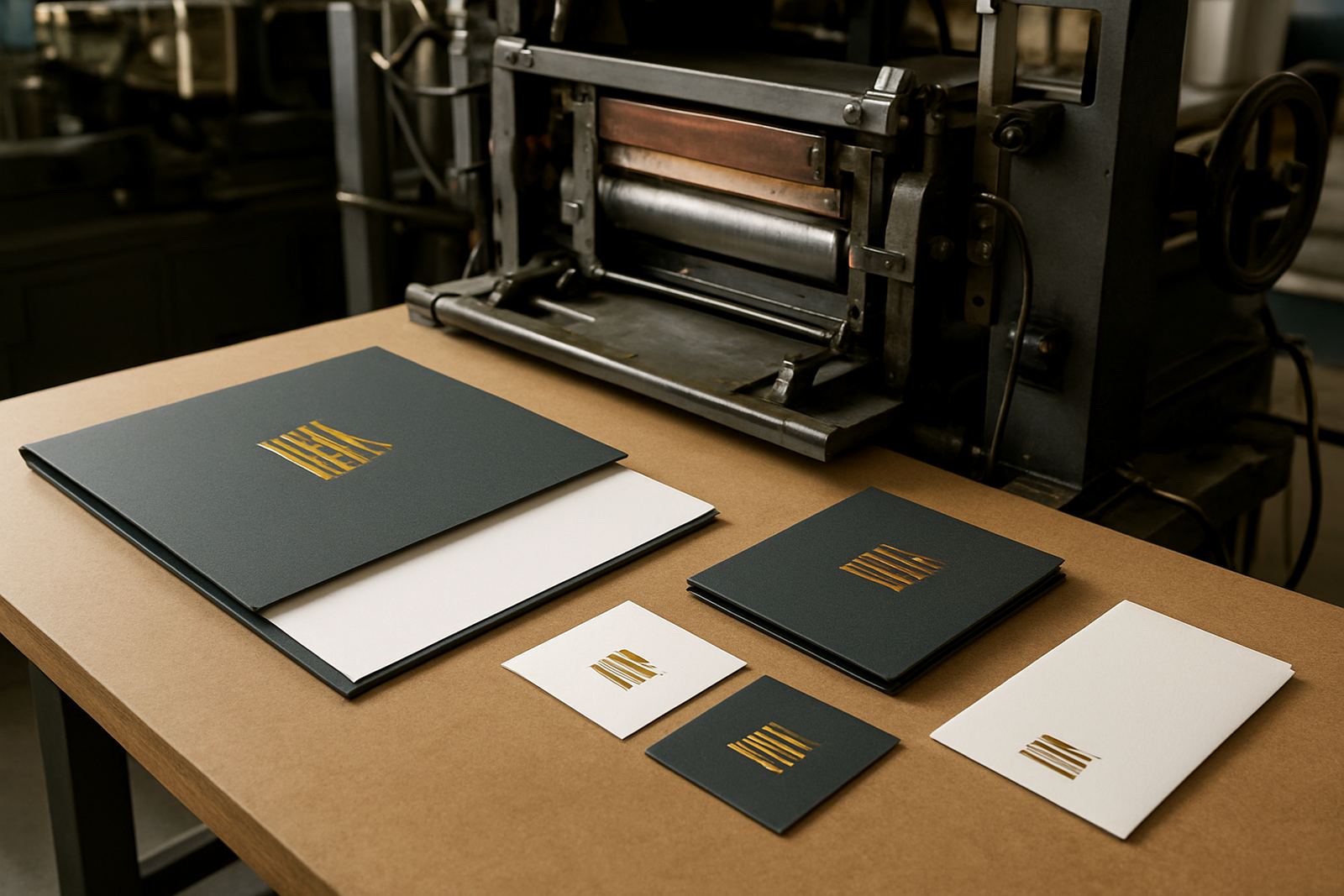
Presentation folders are handled often, stacked, slid into vehicles, and passed from one person to the next. That means the foil needs to sit straight, hold detail on corners and small lettering, and stay consistent from the first folder to the last. A glossy or brushed foil logo can lift a simple folder into something that feels ready for procurement packs, investor meetings, franchise kits, estate agent packs, or school and training materials.
In Johannesburg, Pretoria and the coastal market too, many buyers judge the folder before they read the document inside. A crooked mark or patchy transfer suggests poor control. Good pressing gives sharp edges, even colour transfer and a finish that still looks right after the folder has been carried around in a car boot for a week. That matters for print houses, packaging firms and in-house marketing teams that need repeatable results.
Typical press setup for folder production
For presentation folders, the usual equipment set is a hot-foil stamping press matched to the folder stock, a suitable die, and the right foil grade for coated board, laminated board or textured stock. Many jobs also need a pressure setup that suits the thickness of the folder pocket, flap and spine. If the folders have pockets, business card slits or blind embossing, the platen and make-ready must be set carefully so the logo lands cleanly without crushing the board.
- Hot-foil stamping press sized for A4 and A5 folder work
- Magnesium or brass die, depending on run length and detail
- Foil matched to paper, board or laminated finishes
- Temperature control for small text and fine logos
- Pressure adjustment for pockets, folds and inserts
- Simple jigs or registration stops for repeat position
For smaller runs, a compact press can suit a craft or print studio in Roodepoort or Randburg. Larger manufacturers in Midrand or Germiston often need a wider bed and better throughput. We always look at folder size, stock thickness, foil coverage and daily volume before recommending the setup. That avoids overbuying, and it also keeps changeovers manageable when a job list changes from one client to the next.
Layout choices that keep the folder looking professional
Good layout makes the foil look deliberate. The logo should sit where the eye naturally lands when the folder is opened, but not so close to the fold that it distorts. On most folders, the front cover is the safest location, with the logo centred or placed slightly above centre. When there is a pocket on the inside cover, the finish must be far enough from the glue line and the pocket edge to avoid lifting or uneven pressure.
For municipal tenders, property packs and corporate proposals, less is often better. A single foil mark in gold, silver or a muted metallic tone can look far more refined than a crowded mix of elements. If the artwork includes a fine line, a logo with sharp corners or a small tag line, the die should be tested on the actual board before a full run. This saves rework and wasted folders, which is important when the stock is imported or the job has a tight turn around.
- Keep the logo clear of the fold line by at least 10 to 15 mm
- Leave enough margin from pocket edges and glue zones
- Use strong contrast between foil and folder colour
- Check how the finish reads under office lighting, not only in the workshop
- Test sample folders with inserts before production starts
Common mistakes that waste folders and time
Many problems in folder stamping come from rushing setup. Too much heat can spread the foil or dull the detail. Too little pressure leaves breaks in letters and a patchy logo. If the die is mounted slightly off centre, the mistake becomes obvious on a folder because the eye sees the full front cover at once. Another common issue is ignoring the stock surface. A laminated folder behaves differently from a matt board, and a textured finish often needs a different foil and more careful temperature control.
Load-shedding can also interrupt production if a press is started without a proper plan. Once power returns, the heater may not be stable yet and the first few pieces can be off spec. In humid areas, especially near the coast, foil storage matters as well. Rolls left in a hot storeroom or near an open door can behave badly on press. Good operators keep the rolls sealed, label them by job, and allow the machine to settle before running the batch.
- Wrong heat setting for the board or laminate
- Poor die alignment on a wide folder face
- Foil chosen for paper when the job is on coated board
- Skipping test pulls before the full run
- Not allowing for folds, pockets and card slits
Budget ranges for South African folder jobs
Budgets depend on the press size, the number of folders required, the die material and whether the job is a one-off or a repeated corporate range. For small presentation folder runs, equipment can start with a compact press and basic tooling. A business producing regular folders for clients in Sandton, the West Rand or national accounts may need a stronger machine with better temperature stability and repeat registration. The right choice should match production volume, not just the first quote.
As a working guide, smaller hot-foil press setups for folder work may begin from around R85 000 to R180 000, depending on capacity and controls. Mid-range production presses often sit between R180 000 and R420 000. Larger setups for higher daily output, deeper pressure control and wider beds can move beyond R500 000. Dies, foil stock, servicing and operator training should be budgeted separately, since they all affect the final quality and the true cost per folder. A cheap machine that needs constant adjustment usually costs more over 12 months.
Support for printers, packers and in-house teams
FoilPress works with small craft businesses, print rooms and larger manufacturers from Industria West across Johannesburg and nationwide. We handle press installation, operator training, preventive servicing, breakdown repairs, heater calibration, pressure setup, die mounting, foil matching, spares supply and production optimisation. That matters when a folder line must keep moving for a client launch, a tender deadline or month-end dispatch.
If your team already has a press but the folders are inconsistent, the fix is often in the setup rather than the artwork. A corrected heater setting, better pressure, or a new foil match can make a visible difference within one shift. For businesses in Roodepoort, Randburg, Midrand, Sandton and Germiston, we can help assess the current workflow and improve output without unnecessary replacement. For pricing or technical support, send a message through our contact form.